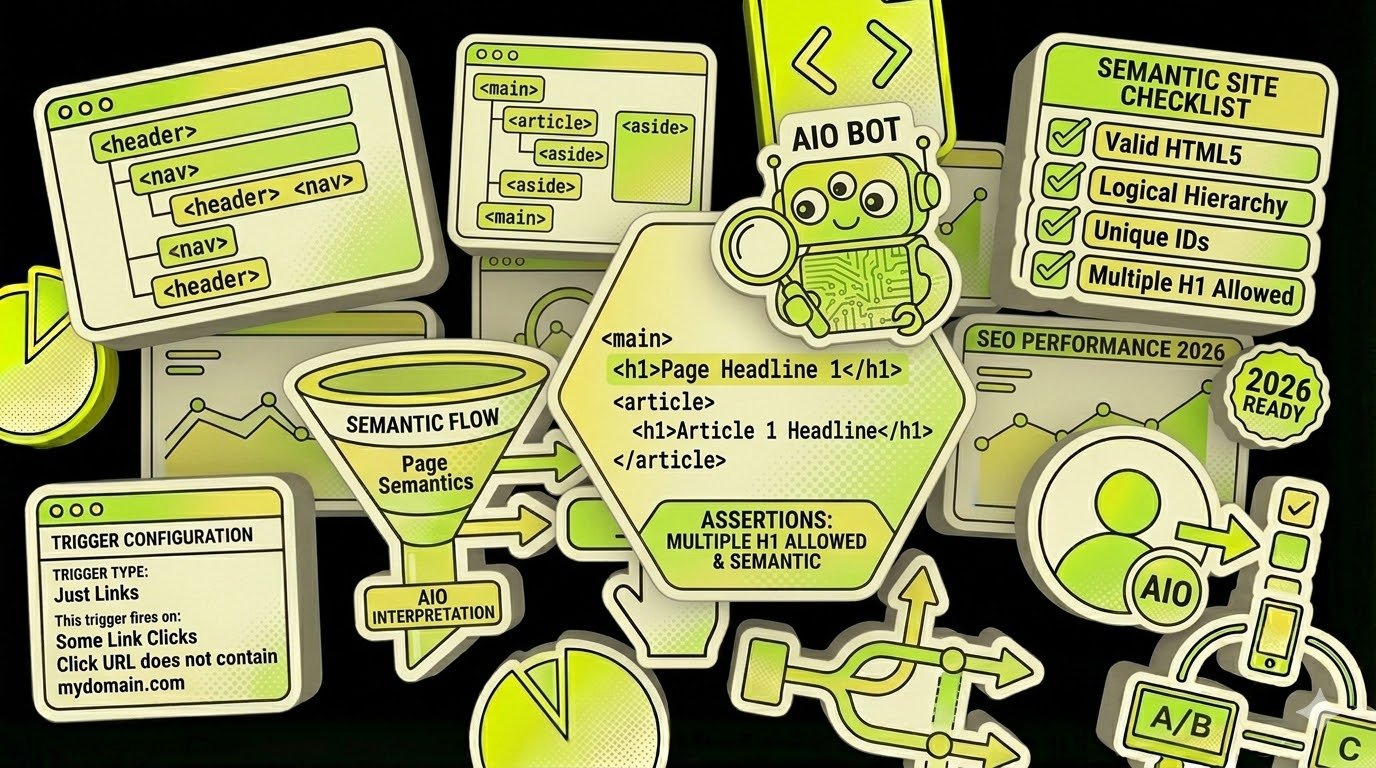
HTML5 has been around for ages, and still a lot of developers “forget” to use semantic tags like: <article>, <aside>, <section>, <main>, etc.
And yes — this matters. Not because tags are magical ranking buttons, but because semantic structure makes pages easier to understand for:
- users,
- screen readers,
- crawlers,
- and now – AI systems that build summaries (hello, Google AI Overviews).
Why semantic HTML is still a strong SEO advantage
Semantic HTML helps search engines understand:
- what is the main content,
- what is navigation,
- what is supplementary content,
- what is a self-contained article,
- and what is just a sidebar widget.
This is not “SEO voodoo”. It’s simply clarity.
And clarity works well with modern search, especially when AI systems try to pull clean pieces of content and cite sources.
Headings (H1–H6)
Let’s talk about the most abused thing in HTML after <br><br><br>: headings.
The old myth: “Only ONE H1 per page!”
This was a common HTML4-era belief.
The HTML5-era confusion
For a while, people said:
“HTML5 allows multiple H1s because each <section> / <article> creates its own outline.”
Reality in 2026: the “document outline algorithm” idea basically didn’t land in the real world the way people expected, and guidance today is much more practical:
- Multiple H1 nested inside sectioning elements used to be discussed as OK, but it’s not considered best practice and is now described as non-conforming in modern guidance.
- Best practical recommendation: use one H1 for the page and then go with H2/H3 hierarchy.
So… can we use multiple H1 for SEO?
Google’s answer: Google’s systems don’t have a problem with multiple H1 headings on a page.
But here’s the nuance (the part that matters in real projects):
✅ Multiple H1 usually won’t “kill your SEO”.
❌ Multiple H1 can still be messy for structure, accessibility, and readability.
So my default rule is simple:
One page = one main intent = one primary H1.
Everything else goes into H2/H3 like a normal person.
Page header and titles
Your page header belongs in <header>.
Usually it includes:
- logo
- navigation
- maybe a search
- sometimes a small tagline
But don’t use H1 for the site name on every page just because the logo is big.
If your template prints <h1>Site Name</h1> in the header on every page, you’re basically telling search engines:
“My page title is always the site name.”
Not great.
Use a <p> or <div> for the logo text, or just an <a> with an image + alt.
Main content area
The main content should go inside <main>.
Important: <main> is for the main content of the page. Not header, not footer, not sidebar.
(Yes, you can place <article> inside <main>. That’s the normal pattern.)
Recommended structure (one H1, clean semantics)
<body>
  <header class="site-header">
    <a class="logo" href="/">Votus</a>

    <nav aria-label="Primary">
      <ul>
        <li><a href="/blog/">Blog</a></li>
        <li><a href="/seo/">SEO</a></li>
        <li><a href="/analytics/">Analytics</a></li>
      </ul>
    </nav>
  </header>

  <main id="content">
    <article>
      <header>
        <h1>Semantic Site Structure: Multiple H1s and the Real SEO Rules</h1>
        <p class="meta">Updated: 2026-02-24</p>
      </header>

      <section>
        <h2>What changed since HTML4</h2>
        <p>H1 is still important, but structure clarity matters more than “H1 religion”.</p>
      </section>

      <section>
        <h2>Best-practice heading hierarchy</h2>

        <h3>One H1 for the page</h3>
        <p>Keep a single main heading that matches the main intent.</p>

        <h3>Use H2 for major blocks</h3>
        <p>Turn H2s into query-shaped sections people actually search for.</p>
      </section>

      <section>
        <h2>FAQ</h2>
        <h3>Will multiple H1 hurt SEO?</h3>
        <p>Google says multiple H1s are fine, but one H1 is cleaner for users and structure.</p>
      </section>
    </article>

    <aside aria-label="Sidebar">
      <h2>Related</h2>
      <ul>
        <li><a href="/semantic-html/">Semantic HTML checklist</a></li>
        <li><a href="/seo-headings/">Heading strategy for SEO</a></li>
      </ul>
    </aside>
  </main>

  <footer class="site-footer">
    <small>© 2026</small>
  </footer>
</body>
Modern guidance also strongly recommends not skipping heading levels, and generally prefers one H1 per page for clarity.
When multiple H1 can be reasonable (rare, but happens)
If you have a page that is basically a list of independent articles, like a portal where each block is truly standalone:
<main>
  <article>
    <h1>MacBook Pro M3 Review</h1>
    <p>...</p>
  </article>

  <article>
    <h1>MacBook Air M3 Review</h1>
    <p>...</p>
  </article>
</main>
Google won’t panic over this.
But for most normal pages — one H1 is still the cleanest solution.
Updated “H1 rules” for 2026 (SEO + accessibility + sanity)
Here’s what I’d update in your original bullet list (and what I would not claim anymore):
✅ What is still correct and useful
- Headings are structural signals, and good structure helps both SEO and UX.
- You can use tags inside headings (like
<span>,<strong>). (Just don’t build a Christmas tree there.) - Title and H1 can match or differ — not a “penalty switch”.
⚠️ What needs modernization
- The old “HTML5 allows multiple H1 per section/article” framing is outdated in practice. Modern guidance says nested multiple H1s were never best practice and are now considered non-conforming; prefer a single H1 and consistent hierarchy.
- Claims like “Google prefers 2 H1” are too strong. Google says it can handle multiple H1, but that doesn’t mean it “likes” them more.
- For other search engines (including regional ones): I wouldn’t state hard rules like “only the first H1 counts” without testing on real projects. Safer best practice: one H1 anyway.
AIO optimization (AI Overviews): how to structure content so AI can quote you
Google has official documentation about AI features and how your content can appear in these experiences.
In practice, if you want better chances to be used/cited:
1) Write in “chunks”
Each important H2 section should follow this pattern:
- H2 = question or clear topic
- First 1–2 sentences = direct answer
- Then: details, examples, code, edge cases
AI loves content that is easy to extract without guessing.
2) Add a mini-summary near the top
A short block like:
- “Yes, multiple H1 is not a SEO disaster”
- “But one H1 is still best practice”
- “Use H2/H3 for structure”
- “Semantic tags help machines understand what is main content”
This also improves user experience and reduces pogo-sticking.
3) FAQ that is real (not spam)
Real questions people ask + short answers. That creates clean Q/A blocks.
4) Keep dates visible
You already did this (Published / Updated). In 2026 it’s even more important for trust.
Final recommendation (simple and practical)
- Use semantic tags properly (
header,nav,main,article,section,aside,footer) - Use one primary H1 for the page
- Build the rest with H2/H3 in a clean hierarchy (don’t skip levels)
- Don’t treat H1 as a styling tool
- Structure your content into extractable blocks for AI features
Leave a Reply